

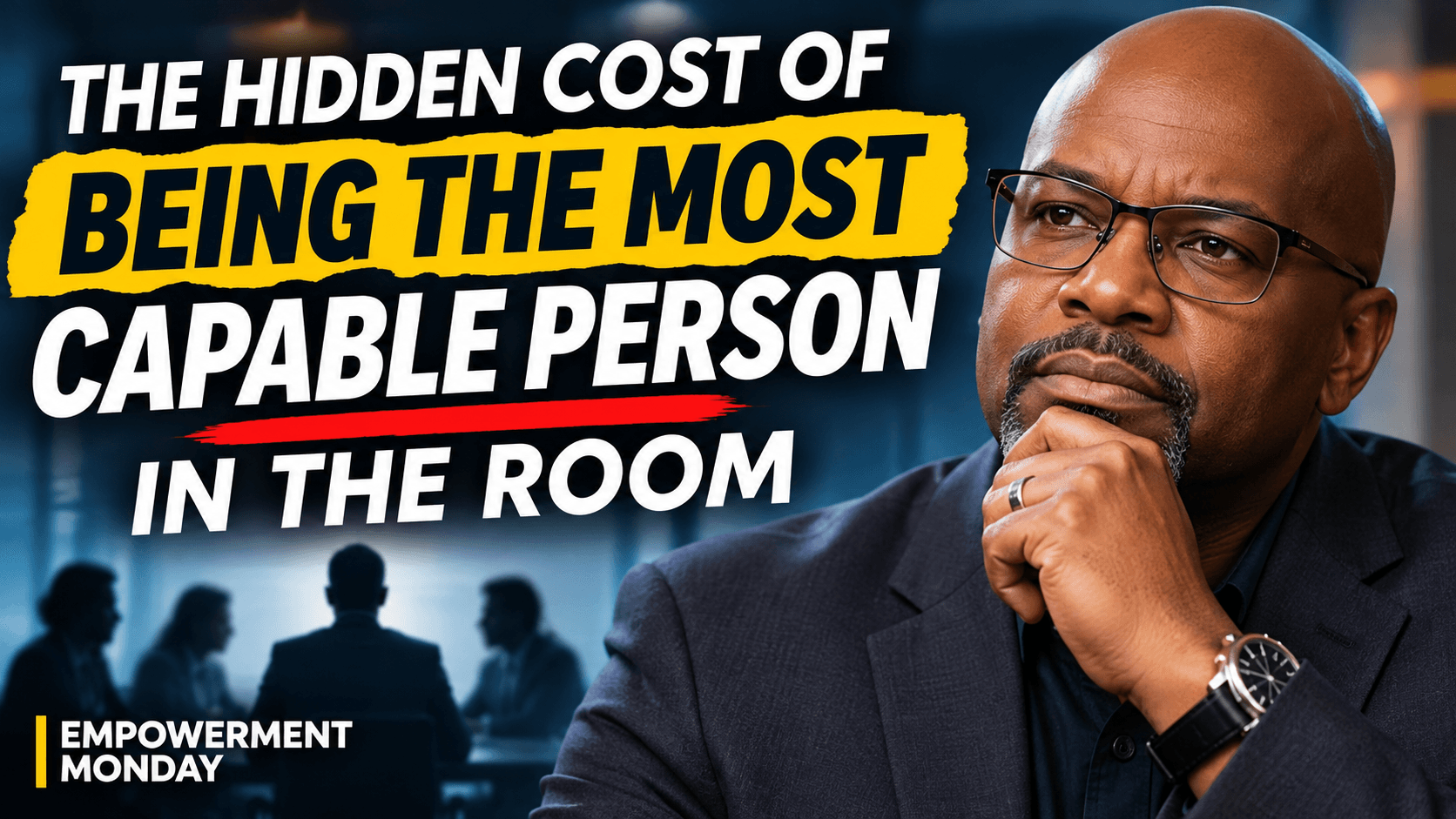
Empowerment Monday | By Nathan R Mitchell, MBA
Just because you can do it better doesn’t mean you should be the one doing it.
There’s a particular kind of exhaustion that comes from being the person everyone depends on.
You’re the one people turn to when decisions get complicated. You’re the one who catches mistakes before they become problems. You’re the one who steps in when deadlines are approaching, expectations aren’t being met, or someone simply doesn’t know what to do next.
And if we’re being fair, there’s something satisfying about being that person.
It feels good to be needed. It feels good to have the answers. It feels good to know that when things get difficult, people trust you to figure them out.
But here’s a question worth considering:
What if your greatest strength is quietly becoming your team’s greatest limitation?
When Competence Creates Dependence
One of the most overlooked challenges in leadership is that highly capable leaders can unintentionally create teams that are less capable than they could be.
Not because they don’t care about developing people. Quite the opposite.
They care so much about the quality of the work, the success of the organization, and the people they serve that stepping in feels like the responsible thing to do.
The problem is that every time we take ownership of something someone else could learn to handle, we may be exchanging their long-term development for our short-term peace of mind.
And over time, that exchange becomes expensive. Decisions slow down because everyone waits for the leader. Creativity suffers because people stop trusting their own judgment. Accountability weakens because responsibility continually moves upward.
And the leader? They become increasingly overwhelmed, wondering why nobody seems willing or able to take more initiative.
Sometimes the very behavior that makes us feel like effective leaders is preventing us from becoming empowering ones.
The Difference Between Being Valuable and Being Indispensable
There’s an important distinction between being valuable to your organization and making yourself indispensable to its daily operations.
A valuable leader builds confidence, clarity, and capability in others. An indispensable leader may unintentionally build a system that struggles to function without them.
The first creates organizational strength. The second creates organizational vulnerability.
Consider two leaders facing the same challenge.
One immediately provides the answer, assigns the tasks, and monitors every detail. The other asks thoughtful questions, clarifies expectations, establishes appropriate boundaries, and gives the team room to determine the best path forward.
Both may achieve the desired result. But only one is intentionally developing the team’s ability to succeed without constant intervention.
And that difference matters.
Because leadership isn’t measured solely by what gets accomplished while you’re in the room. It’s also measured by what continues to happen when you’re not.
Three Shifts That Build Stronger Teams
If you recognize yourself in this conversation, consider making three intentional shifts.
1. Replace immediate answers with better questions.
Before offering a solution, ask:
- What have you considered so far?
- What do you believe is the best next step?
- What information would help you make this decision?
You don’t have to withhold guidance. You simply need to create space for others to think before you think for them.
2. Delegate ownership, not just activity.
There’s a difference between assigning someone a task and trusting them with responsibility.
When we delegate only the work but retain every meaningful decision, we haven’t truly empowered anyone. We’ve simply redistributed our to-do list.
Clarify the desired outcome, establish decision-making boundaries, and allow people to exercise judgment.
3. Become comfortable with someone else’s approach.
This may be the hardest shift of all.
Someone else may accomplish the same objective differently than you would.
Their process may not be as polished. Their first attempt may take longer. They may even make a few mistakes along the way.
But different doesn’t automatically mean ineffective.
And growth rarely happens without some degree of discomfort.
The goal isn’t to lower standards. It’s to stop confusing your preferred method with the only acceptable method.
Your Empowerment Monday Challenge
This week, identify one responsibility, decision, or recurring problem that consistently finds its way back to you.
Then ask yourself:
Am I involved because my leadership is genuinely required, or because I’ve never created the conditions for someone else to succeed?
If it’s the latter, consider what would happen if you stepped back just enough to let someone else step forward.
You might discover that the greatest contribution you can make isn’t another answer, another solution, or another task completed.
It might be the confidence you help someone else develop.
A Final Thought
The strongest leaders aren’t necessarily the ones who can do everything.
They’re the ones who develop people who can accomplish things they once believed only they could do.
Your leadership legacy won’t be defined by how much people needed you. It will be defined by how much stronger they became because of you.
Keep leading. Keep growing. Keep empowering.
Featured Affiliate






Share Your Field Notes: Add to the Journey!