

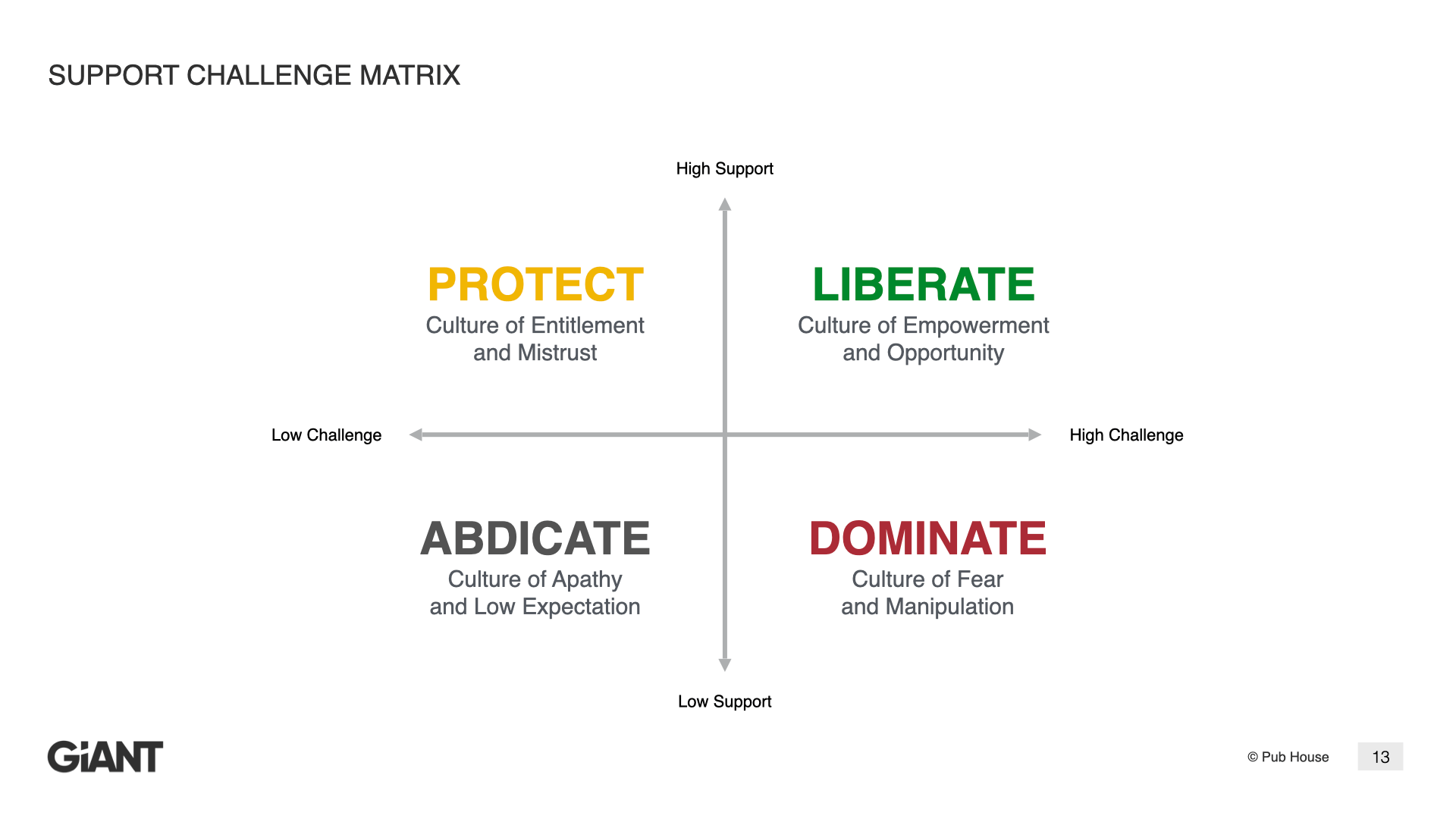
Leadership is often described as a balance — between being kind and being firm, between empowering people and holding them accountable. Too much softness, and you get walked over. Too much toughness, and you lose the trust of your team. GiANT Worldwide captures this tension perfectly with one of their most practical leadership tools: the Support Challenge Matrix.
What is the Support Challenge Matrix?
At its core, the Support Challenge Matrix is a visual tool that helps leaders evaluate their leadership style based on two dimensions: Support and Challenge.
- Support is about care, encouragement, resourcing, and relational trust.
- Challenge is about expectation, accountability, pushing for excellence, and telling hard truths.
When these two forces are balanced well, a leader creates an environment where people feel both valued and stretched — a place of empowerment.
The matrix forms a grid with four quadrants:
- Liberate (High Support, High Challenge)
- Protect (High Support, Low Challenge)
- Dominate (Low Support, High Challenge)
- Abdicate (Low Support, Low Challenge)
Let’s explore each.
1. Liberate: High Support, High Challenge
This is the sweet spot. Leaders in this space create environments where their people feel genuinely cared for and held to high standards. Think of a coach who knows when to give encouragement and when to push you harder because they believe in you.
A liberating leader asks questions like:
- “What do you need from me right now?”
- “What obstacles are in your way?”
- “What’s your next step — and how will you own it?”
People under liberating leadership grow. They feel safe to fail, but also pushed to succeed.
2. Protect: High Support, Low Challenge
These leaders are nice — sometimes too nice. Their team likes them, but performance may lag because expectations are unclear or rarely enforced. Over time, people plateau, coasting in comfort zones that never get challenged.
This quadrant often stems from a fear of conflict. Leaders here might avoid tough conversations or over-help their team, unintentionally fostering dependence instead of growth.
Ask yourself: Am I holding back from delivering needed feedback because I don’t want to hurt someone’s feelings?
3. Dominate: Low Support, High Challenge
Now flip the script. This quadrant is about high expectations with little empathy. Leaders here tend to micromanage, critique harshly, or drive performance without building trust or connection.
Sure, results may come — but at a cost. Burnout, turnover, and low morale are common in this space. Team members comply but rarely commit. Over time, they may become disengaged or even resentful.
If you’re often frustrated that people “don’t get it” or aren’t “tough enough,” it might be worth checking how much support you’re actually providing.
4. Abdicate: Low Support, Low Challenge
This quadrant is disengaged leadership — people who’ve checked out or never really stepped up. They neither support nor challenge their team. Maybe they’re overwhelmed, burned out, or simply unsure of what good leadership looks like.
This can breed chaos or apathy. Without clear direction or care, teams either splinter or stagnate.
Leaders here need re-engagement — either through coaching, clarity, or recalibration of vision and energy.
Why It Matters
Great leadership is not about being everyone’s best friend, nor is it about driving people relentlessly. It’s about knowing what your team needs, when they need it, and being emotionally intelligent enough to adjust.
The Support Challenge Matrix gives leaders a mirror. It’s not about labeling yourself — it’s about awareness and intentionality. You can ask:
- “Where do I tend to live?”
- “What does my team actually need right now?”
- “Am I afraid of conflict? Am I showing too little empathy?”
Leadership is not static. Different seasons, team members, or circumstances require different balances. The magic happens when you can flex between high support and high challenge consistently.
How to Use It
- Self-assess: Plot yourself on the matrix. Ask your team for feedback, if you’re brave enough.
- Diagnose your team: Where are they? Are they coasting, stressed, apathetic?
- Adjust your posture: Stretch yourself. If you’re overly protective, lean into hard conversations. If you’re dominant, ask more questions and show more empathy.
Final Thought
The Support Challenge Matrix isn’t just about leadership in the workplace — it’s about influence in life. Parents, teachers, mentors, coaches — we’re all shaping others. The goal? To lead in a way that liberates people to grow, take ownership, and thrive.
Because the best leaders don’t just get results. They leave people better than they found them.
You may reprint this post in your own print or electronic newsletter, but please include the following: “Reprinted with permission from the Lead Empowered Blog: For a free subscription, go to http://www.LeadEmpowered.com. Copyright 2025 Nathan R Mitchell – Lead Empowered.”
Looking to increase your self-awareness and have a better understanding of your leadership behaviors and tendencies? Try the FREE 5 Voices Assessment.




Share Your Field Notes: Add to the Journey!